How to Sell on Instagram Without a Website in India (2026 Guide)

Most Indian sellers on Instagram do not lose orders because the product is wrong or the photos are bad. They lose them in the gap between "price?" and the reply. A buyer who comments at 10pm and gets an answer at 9am has, in the meantime, seen four competing accounts.
You do not need a website to close that gap. You need the price, the payment link and the delivery answer to arrive while the buyer is still looking at the post.
Why the DM is the checkout page in India
In markets where card-on-file checkout is normal, the job of social media is to send traffic to a cart. In India it usually is not. UPI made paying trivial — four taps and it is done — but it did nothing to make deciding trivial. Indian buyers ask before they buy: is this the real price, will it ship to my pincode, is COD available, can I get it by Friday.
Those questions arrive in comments and DMs, constantly. A boutique posting three reels a week can field a few hundred a month. Answering them by hand is not a scaling problem, it is a timing problem. The answer is worth a great deal at minute one and almost nothing at hour twelve.
That is the whole argument for handling it in the DM. Not because a website is bad, but because the buyer already has Instagram open and will not leave it to fill in a shipping form on a site they have never seen.
What you actually need
Four things, none of which is a website.
A Professional account. Business or Creator, either works. This is what makes the account eligible for Meta's messaging API. Switching costs no reach, resets nothing, and takes about two minutes in settings.
A payment collector. Razorpay is the standard choice in India because it generates UPI intent links that open GPay, PhonePe or Paytm directly, and because its webhook fires the instant a payment succeeds. You will need PAN and bank details for KYC.
Written answers to the three questions. Not templates with blanks — finished sentences with the actual numbers in them. This is the part sellers skip, and then wonder why the automation underperforms.
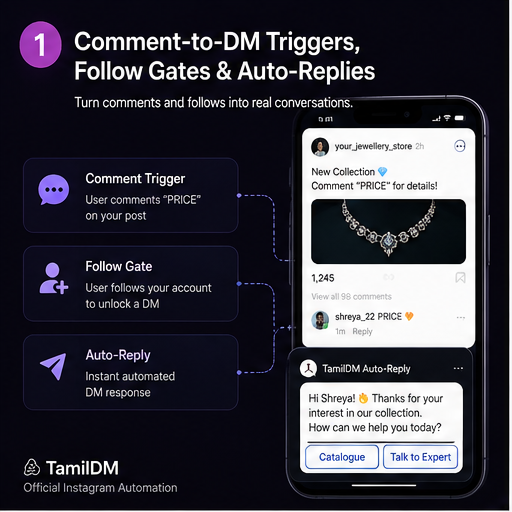
A trigger layer that watches for the words buyers type and sends the matching answer. That is what instagram dm automation does, and the one technical requirement worth insisting on is that it runs on the meta business api rather than on a bot that logs into your account and clicks buttons.
The most expensive mistake in this setup is using a tool that asks for your Instagram password. Official tools never do — they use Facebook OAuth, where you grant a permission and can revoke it at any time, and Meta knows the traffic comes from an approved integration. A tool holding your password is simulating a human, which is exactly the pattern that gets accounts restricted.
Building the flow, step by step
Decide what the trigger words really are
Sellers write triggers for the words they wish buyers used. Buyers use their own. Pull up your last fifty comments and read them. You will find price, Price, pric, rate, how much, cost, dm me, dm pls, and a dozen variants with half the vowels missing.
Set them all. A trigger that misses a third of the ways people ask is a trigger that fails a third of the time — silently, and you will never see the orders you did not get.
Write the reply as a complete answer
Compare these two:
Hi! Thanks for your interest. Please DM us for details!
This one is ₹1,450 including shipping anywhere in India. Delivery is 3–5 days. Pay here and it ships today: [link]
The first is a reply. The second is a sale. The first forces the buyer to ask a second question, which means waiting again, which means the point of automating was lost.
Put the number in the message. Put the link in the same message.
Answer COD before it is asked twice
In most Indian categories — apparel, accessories, home, jewellery — COD is the second question, and for a large share of first-time buyers it is the deciding one. Give it its own trigger (cod, cash, cash on delivery, delivery charge) and answer it completely: whether you offer it, which pincodes, what it costs extra, and what happens on a return.
If you do not offer COD, say so plainly and immediately. A clear no at minute one costs you far less than a maybe at hour ten.
Attach payment where the decision happens
The reply that quotes the price carries the payment link. Not the next message, not the follow-up. A UPI intent link opens the buyer's payment app straight from the DM, so the distance between "I want it" and "paid" is two taps.
When the payment succeeds the webhook fires, and the automation can send the confirmation, the download link for a digital product, or the address question for a physical one — within seconds, without you touching it.
Gate the link on a follow, when it is worth it
If your goal is audience and not just this one order, you can require a follow before the link is delivered. It works because the buyer is at peak intent: they want the thing, and following costs them nothing. It stops working if you apply it everywhere, because a buyer who already follows you being asked to follow you reads as broken.
Use it on high-reach posts. Never on customer support.
Test the whole thing as a buyer
From a second account, comment the trigger word on a live post. Follow every message through to the payment screen. Pay one rupee. Confirm it lands in the dashboard and that the confirmation DM arrives.
Sellers skip this and discover the broken link after a reel does two hundred thousand views.
What this costs at different stages
The figures below are TamilDM's published plan limits, and they are a reasonable way to size what "enough" means for a shop at each stage.
A shop doing three posts a week with moderate engagement rarely exceeds the free tier. A brand running paid traffic to reels will pass it in the first month. Both are fine — the point is that the cost of answering every buyer instantly is small next to the cost of not.
The rules you have to respect
Automation on Instagram is allowed. Spam is not, and Meta draws the line in a specific place.
You may reply. Someone comments, mentions you in a story, or messages you, and you may respond automatically — including with a link. This is the designed purpose of the messaging API.
You may not initiate. You cannot automate a first message to someone who has not interacted with you. Cold DMs are not a grey area; they are the thing the permission model exists to prevent.
There is a messaging window. After a user interacts you have a standard window to reply freely, and beyond it message types are restricted. Well-built tools handle this for you, but it is worth knowing it exists, because it explains why a reply to a three-day-old comment behaves differently from a reply to a fresh one.
Quality is measured. Meta scores messaging quality on blocks and reports. Sending everyone an identical message is the fastest way to degrade it. Varying replies and triggering only on real intent is not a trick — it is the behaviour the system is built to reward.
Most of what separates official vs unofficial automation reduces to this: official tools operate inside these rules by construction, and unofficial ones operate outside them until the account is caught.
When you do actually need a website
Honestly: when you carry more than a few dozen SKUs, when buyers need to browse and compare before deciding, when you want to run retargeting properly, or when you are large enough that a DM thread per order becomes the bottleneck rather than the accelerator.
Selling in the DM is not a permanent substitute for a store. It is the right shape for the stage most Indian Instagram sellers are actually at, where the constraint is answering fast rather than displaying inventory.
Frequently asked questions
601Is it legal to sell on Instagram without a website in India?
02Do I need GST registration to take UPI payments on Instagram?
03Can I collect Cash on Delivery through Instagram DM automation?
04What happens if Instagram changes its API rules?
05How fast does the money actually reach my bank account?
06Will automating replies make my account look like a bot?
Ready to Safe-Automate Your Instagram?
Connect TamilDM using Meta's official API to handle auto replies, stories, and DM flows securely. Start free in under 5 minutes.
Recommended Guides & Tutorials
GuidesHow to Sell Digital Products & Collect UPI Payments Directly in Instagram DMs
Learn how to connect Razorpay & UPI payment links to your Instagram DM automations to sell eBooks, courses, and digital products on autopilot.

TamilDM Team
Product & Growth
 Guides
How to Setup an Ask-to-Follow Gatekeeper on Instagram to 10x Follower Growth
Learn how to turn viral Reel comments into loyal followers using TamilDM's official Meta Graph API Ask-to-Follow gatekeeper before delivering private DM links.
Sri Guru
Founder
 Guides
How to Automatically DM Someone Who Comments on Instagram (Step-by-Step)
Learn how to set up automated comment-to-DM triggers on Instagram Reels and posts safely using Meta's official Graph API.
TamilDM Team
Product & Growth