Instagram Automation Rules: What Meta Actually Allows in 2026
Almost every question about Instagram automation safety is really the same question asked in different words: will this get my account banned?
The answer is knowable, because Meta does not leave it to interpretation. There is a published permission model, an app review process, and a set of enforcement signals. Understanding those three things tells you exactly where the line sits — and it turns out the line is not where most people assume.
The distinction that actually matters
There are two ways a piece of software can act on your Instagram account.
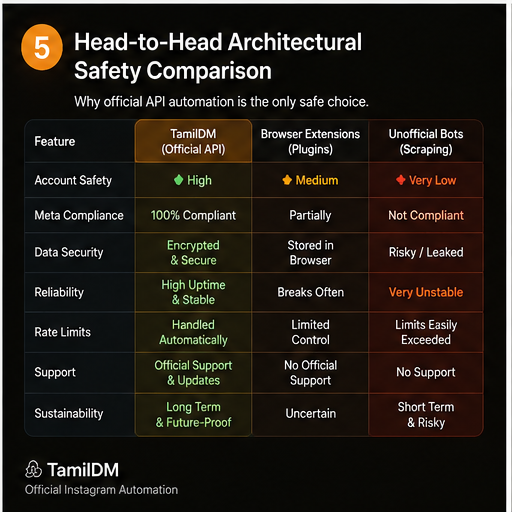
Authorised. The tool is registered as a Meta app, has passed app review for the permissions it requests, and connects through Facebook OAuth. You grant it access, Meta records that grant, and every request it makes is identified as coming from that app. You can revoke it in your settings at any time. Your password is never involved.
Unauthorised. The tool holds your username and password, logs in as if it were you, and issues requests that pretend to come from the Instagram mobile app. Meta has no record of an integration, because there isn't one — from the platform's side this is indistinguishable from a stolen credential being used from somewhere unusual.
Everything else — features, pricing, interface quality — is downstream of that choice. A tool in the first category sends a message and Meta sees an approved app doing a permitted thing. A tool in the second sends the same message and Meta sees an unrecognised session behaving in a way no human hand produces.
This is why unofficial bots get accounts restricted at message volumes an official integration handles without a flicker. The volume was never the trigger.
What you are allowed to automate
Meta's messaging permissions are narrower than most marketing copy implies, and it is worth knowing them precisely.
Replies to interactions — allowed
If a user does something that opens a conversation, you may respond automatically:
- Comments on your posts and reels
- Replies to your stories, and story mentions
- Direct messages the user sends first
- Clicks on a click-to-message ad
- Replies to a message you sent inside an open window
This covers the entire useful surface of what sellers and creators want. Comment automation sits squarely inside it: someone comments, you reply, publicly or privately or both.
First contact — never allowed
You cannot automate a message to someone who has not interacted with you. There is no permission that unlocks this, no plan tier that includes it, and no legitimate tool that offers it. Any product advertising automated cold DMs is, necessarily, using an unauthorised method.
If you find that limitation frustrating, it is worth sitting with why it exists: an inbox where any business can bulk-message any user is an inbox no one opens.
The messaging window
After a user interacts, a standard window opens during which you can send freely. When it closes, only certain message types remain available.
Practically, this means:
- A reply to a comment from ten minutes ago goes out normally.
- A reply to a comment from four days ago is subject to the restriction.
- A follow-up sequence has to be built around the window, not in spite of it.
Good tools track this per-conversation and will simply not send something that would fall outside the rules. This is a feature, not a limitation — it is the mechanism that keeps your account out of trouble automatically.
If a tool lets you schedule an automated message to a contact who last interacted two weeks ago, that is a strong signal it is not going through the official API at all. The API would refuse.
How enforcement actually works
Meta's enforcement is not a single ban switch. It is graduated, and understanding the ladder helps you read what is happening if something goes wrong.
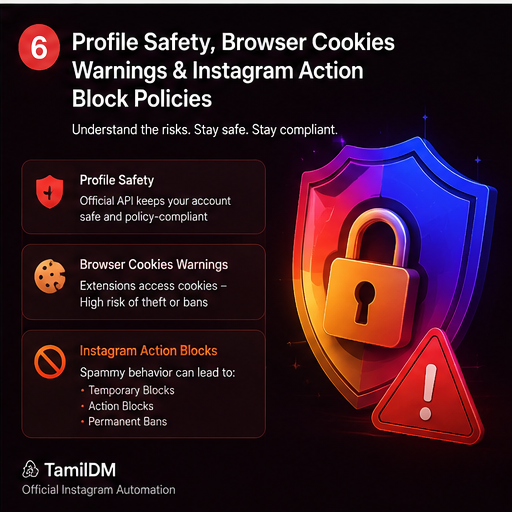
Action blocks are the first rung — a temporary inability to comment, follow, or send messages, usually measured in hours or days. This is a rate or pattern signal, not an accusation of anything serious.
Feature restrictions are longer and narrower: messaging works but reach is limited, or a specific capability is withdrawn. This is where sustained low messaging quality tends to land you.
Account restrictions and disablement are the end of the ladder, and they generally follow either repeated ignored warnings or a clear authentication violation.
The signals that drive all of this fall into three groups.
Authentication anomalies
The strongest signal, and the one you have least control over once you have handed a password to a third party. A session that logs in from a datacentre IP, from a device fingerprint that does not match your phone, at intervals no human produces, is anomalous in a way that is trivially detectable at Meta's scale.
Messaging quality
Meta measures how people react to messages from your account. Blocks and reports are the primary inputs. This is where automation quality becomes an account-safety issue rather than just a conversion issue:
- Everyone who comments any word gets the same message → high report rate
- Only people who typed a buying keyword get a specific, relevant answer → low report rate
The second pattern can run at ten times the volume of the first and stay healthy, because the recipients wanted what they got.
Content signals
Links to domains with poor reputations, messages that look like a known scam pattern, and repeated identical text all contribute. Nothing exotic — but worth noting that a message template is not automatically safe just because you send it from an approved app.
The safety practices that measurably help
Trigger on intent, not on presence. A trigger on the word price reaches people who want to buy. A trigger on any comment reaches people who said "nice" and did not want a sales pitch. The second one is what generates reports.
Vary the wording. Two or three variants of each reply, rotated, is enough. Identical strings at volume are the single clearest spam fingerprint there is.
Answer the question that was asked. A reply that does not match the trigger is worse than no reply, and it is the fastest route to a block.
Keep the automated part short. Automation is best at the first response, when speed matters most. Hand the conversation to a human once it turns into a real back-and-forth.
Never buy engagement alongside automation. Purchased followers and comment pods are separately penalised, and they contaminate the signals your legitimate automation is being judged on.
Revoke access you no longer use. Every connected app is a live grant. Old integrations you have forgotten about are still authorised to act.
If your account is already restricted
The order matters here.
- Revoke the tool's access in Instagram settings, and in Facebook's Business Integrations if it connected there.
- Change your password if you ever gave it to a third party — and enable two-factor authentication, which also blocks password-based bots from reconnecting.
- Stop all automation for the duration of the restriction. Continuing while flagged extends it.
- Wait. Most action blocks clear on their own. Appeals are worth filing for longer restrictions but rarely accelerate a short one.
- Reconnect through OAuth only when the restriction has lifted, and start at low volume.
Switching tools does not undo a penalty. It removes the cause, which is what stops the next one.
The short version
Meta is not opposed to automation. It built the API, it reviews the apps, and it approves the integrations — because a business that answers customers in one second is a business whose customers stay on Instagram.
What Meta is opposed to is software impersonating a person, and messages nobody asked for. Stay on the approved side of both and the safety question mostly stops being a question.
Frequently asked questions
701Is Instagram automation against Instagram's terms of service?
02Can I automatically DM someone who has never contacted me?
03What is the 24-hour messaging window?
04Why do accounts using unofficial bots get restricted even when they send few messages?
05What is a messaging quality score and how do I protect it?
06If my account is already restricted, does switching to an official tool fix it?
07Does automating comment replies affect my reach?
Ready to Safe-Automate Your Instagram?
Connect TamilDM using Meta's official API to handle auto replies, stories, and DM flows securely. Start free in under 5 minutes.
Recommended Guides & Tutorials
SafetyOfficial vs Unofficial Instagram Automation: The Safety Comparison
Compare official Meta Business API solutions with unofficial browser extensions and headless scrapers to protect your account health.

TamilDM Team
Product & Growth
 Safety
Why Unofficial Instagram Bots Get Accounts Restricted
Learn why using unofficial Instagram automation bots causes action blocks, restrictions, or account bans, and how to automate safely using Meta's official API.
TamilDM Team
Product & Growth
 Guides
How to Block Spam Comments & Auto-Reply on Instagram & YouTube with AI Shield
Protect your brand reputation and automate YouTube and Instagram comment replies with TamilDM's AI Comment Shield and auto-moderation engine.
Sri Guru
Founder